Gemini Robotics 2 links task planning with whole-body robot control
Google DeepMind’s July 30 launch separates reasoning, motor execution and on-device operation across three models. The different roles and access levels matter when interpreting its demonstrations.

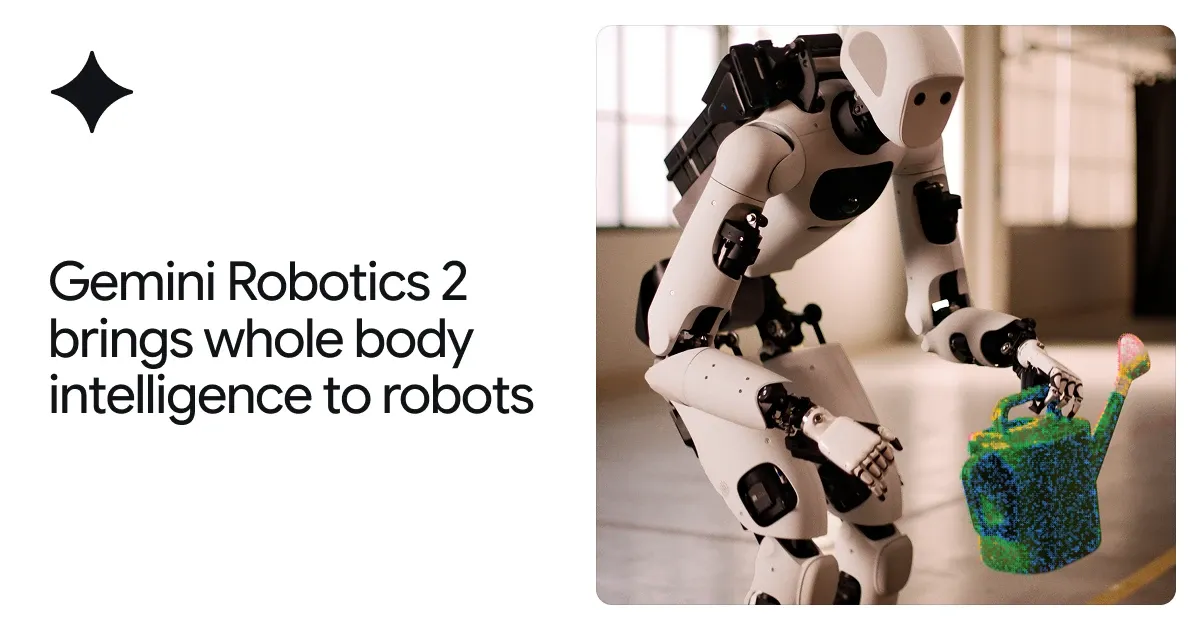
Google DeepMind introduced the Gemini Robotics 2 family on July 30, 2026. It divides work among understanding and planning a task, converting visual and language inputs into movement, and running a model locally on a robot.
The announcement emphasizes whole-body control, dexterous manipulation and cooperation between robots. These capabilities are presented through the provider’s demonstrations and evaluations, which provide the context for interpreting its results.
Three roles in the system
| Model | Main role |
|---|---|
| Gemini Robotics 2 | Converts vision and language into motor control |
| Gemini Robotics ER 2 | Interprets the environment and plans multi-step tasks |
| Gemini Robotics On-Device 2 | A motor-control model optimized for local operation |
Consider the instruction “Put this object in the box.” Completing it involves identifying the object and destination, deciding how to reach them, executing movement and checking the outcome.
Separating those roles helps developers locate a problem. Did it occur during interpretation, planning, movement or verification of completion?
A team could devise a short test for each stage before examining the full sequence. That would expose the relationship between a successful component and the task the user actually requested.
Tracking progress during execution
Google’s technical introduction describes ER 2 using continuous video to track progress, while handing motor execution to a VLA model or control tools.
In an illustrative evaluation, the team could define the task’s starting point, intermediate stages and completion condition. If an object falls from the robot’s grip, the evaluation could examine when the system recognizes the change and what it does next.
That example would need to be tested on the actual robot and task. Recording the surrounding conditions would also make differences between repeated trials easier to interpret.
Writing the expected result beforehand helps distinguish completing the task from performing a correct movement during one stage.
Access differs across the family
The Gemini API release notes identify ER 2 and ER 2 Streaming as public-preview models. DeepMind says the VLA and On-Device models are available to early-access partners, with Gemini Enterprise Agent Platform in private preview.
The family provides a broader approach to connecting planning with movement. Full-task evaluations, error cases and stopping behavior remain useful ways to understand where a particular implementation fits, alongside the model and access level available to its developers.
Sources
Founder and editor-in-chief of Kurd Developers. Phone and tech news on YouTube, Instagram and TikTok.
More stories
Apple Intelligence Is Coming to China With iOS 27.3, Backed by Alibaba
After more than two years of waiting, Apple says Apple Intelligence will reach iPhone users in China in December, with Alibaba's Qwen model powering parts of Siri.
One text can break your phone: Android's 'SMS of Death' explained
A flaw in Android 12 and later lets a specially crafted SMS drop calls and even make a phone unusable. The fix is in October's security patch.

GTA VI lands November 19: prices, editions and what to know
Rockstar has locked the date: Thursday, November 19 on PS5 and Xbox Series X|S. Standard costs $79.99 and Ultimate $99.99.

Apple's first touchscreen MacBook Pro brings OLED and Dynamic Island
The new PROLED XDR display responds to touch, the notch is gone and Dynamic Island takes its place. Prices start at $2,899.