Azure expands with AMD Helios and EPYC across three upcoming VM families
Microsoft’s July 20 announcement outlines HDv2, HXv2 and ND MI455X v7, each targeting a different part of AI and HPC work.

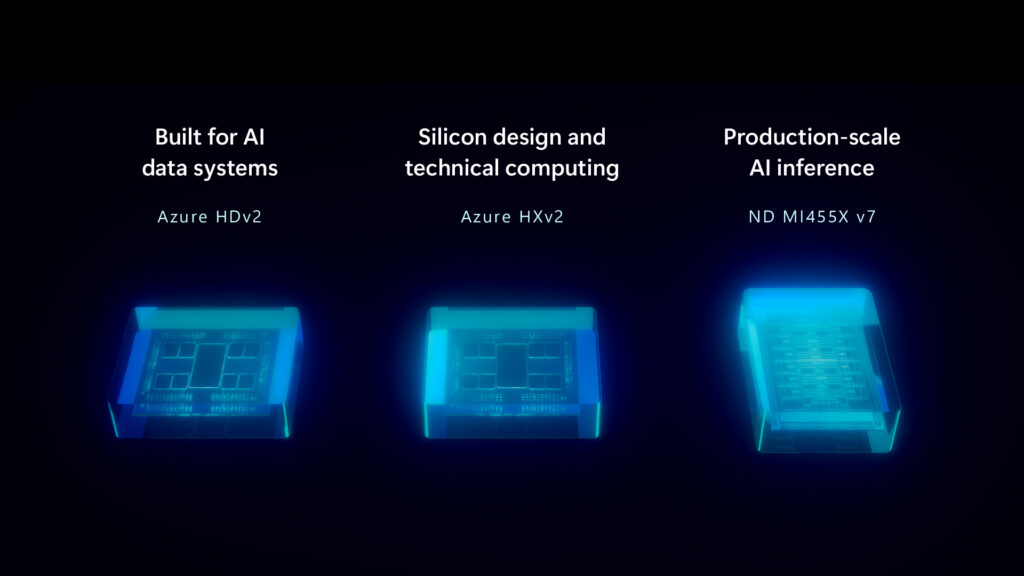
Microsoft announced an expansion of Azure infrastructure with AMD Helios and next-generation EPYC on July 20, 2026. The plan identifies three upcoming virtual-machine offerings for data systems, chip design and inference.
Three families, different roles
| Offering | Announced role |
|---|---|
| HDv2 | AI data systems |
| HXv2 | Chip design and technical computing |
| ND MI455X v7 | Large-scale AI inference |
The announcement describes these offerings as upcoming. Today is therefore the plan’s announcement date; availability for each service requires its own details.
That distinction is useful when following cloud infrastructure. Identifying a family and its intended workload is one step; being able to deploy it in a particular region is another.
The Helios background
AMD previewed Helios at CES in January 2026 as a rack-scale platform combining Instinct MI455X GPUs and EPYC “Venice” CPUs.
That supplies the technical background to the name. Today’s announcement adds a connection to specific Azure offerings. Introducing a platform and planning to deliver it through a cloud service represent different stages in reaching a customer.
Choosing a VM means choosing resources
Microsoft’s guidance explains that VM size determines processing power, memory, storage capacity and network bandwidth. Selection therefore involves more than the name of a CPU or GPU.
Consider an application that cleans and organises data, calls a model and stores the result. Preparation and inference do not ask identical questions of the system, illustrating why several resource families can be useful.
The user’s experience also follows the complete path. If time is spent before a request reaches the model, measuring model response alone will not explain total task duration.
Start a comparison with the work
A team can measure data preparation, request execution and result storage separately. Once those stages are visible, it becomes easier to identify which component could change the practical outcome.
A fixed example with a known data size and a defined result can then provide a basis for comparison. The exercise remains connected to the application’s needs rather than assuming one family suits every task.
The direction of the announcement is workload-specific choice. For an Azure user, the practical question is where the application waits and which resources fit that stage. The task’s actual result can then become the basis for assessing the new offerings when available.
Sources
Founder and editor-in-chief of Kurd Developers. Phone and tech news on YouTube, Instagram and TikTok.
More stories
Apple Intelligence Is Coming to China With iOS 27.3, Backed by Alibaba
After more than two years of waiting, Apple says Apple Intelligence will reach iPhone users in China in December, with Alibaba's Qwen model powering parts of Siri.

One text can break your phone: Android's 'SMS of Death' explained
A flaw in Android 12 and later lets a specially crafted SMS drop calls and even make a phone unusable. The fix is in October's security patch.

GTA VI lands November 19: prices, editions and what to know
Rockstar has locked the date: Thursday, November 19 on PS5 and Xbox Series X|S. Standard costs $79.99 and Ultimate $99.99.

Apple's first touchscreen MacBook Pro brings OLED and Dynamic Island
The new PROLED XDR display responds to touch, the notch is gone and Dynamic Island takes its place. Prices start at $2,899.